
Knitting is a vice like any other. It can be carried too far. It can strain your eyesight, your temper, your reason. From apathy toward the subject, an amateur usually progresses to overinvolvement.… Take it easy. It can become obsessive. It can also serve as an excuse to avoid honest, sustained conversation.
—Thomas E. Doremus, The Atlantic, 1958
Red hats are being knit in Minneapolis to demonstrate solidarity for community members who are, as of my writing this, being threatened by federal agents with long leashes and little training. That's not what this post is about. If you want an opinionated digest of that, I recommend Natalie's Your Crafting is NOT Resistance and follow-up video Who Gets to Call Something 'Resistance'?
This post is an attempt to answer for myself: What does it matter if I knit?
Honest, sustained conversation is not the only thing you can avoid by knitting. You can tune out a spread of alternatives with the soothing, tunnel-visioning effect of two needles, hands, some wool and a plan. It appears virtuous, in contrast to the zombie-eyed doom-scrolling peers of your generation, but this is a convenient illusion. I dusted off this mirror in the mechanics of the boyfriend sweater curse and now I'm going to stare into it.
Before I learned about the red hats, YouTube suggested I watch a video touting knitting as an act of subversion. The creator, a retired professor, discussed the sociopolitical value of fibre arts. The argument was not very convincing but invested as I am in the hobby, I figured it would be worth it to stick it out to the end. Would it veer into utter delusion or present something credible?
Reader, I still don't know. I haven't been able to stop thinking about it. There's nothing about this particular video that made me respond in such a way; I think it was just lucky to be my first contact with the idea.
Let's say knitting is an act of resistance. What does it resist, exactly? Is it working?
It has to be addressed, before I can take a stab at the question: if I have to ask "What am I subverting?", the purported subversiveness probably wasn't intentional and definitely isn't the main motivation. And I'm not an expert, but I think incidental resistance smells faintly of bullshit.
subvert
to overturn or overthrow
from the foundation
...yeah, sounds hard, even with concerted effort.
While I wouldn't say I'm overthrowing fast fashion, knitting does support my values of ethical production1, supporting the local economy, and investing in durable, well-made, high-quality materials. These values were solidly in place before I ever considered knitting garments.
Most people don't make their own clothes! They go to Simons or Uniqlo or Aritzia. But these clothes suck. There are only so many times a person of my constitution can experience the disappointment of an overpriced garment fraying after half a dozen wears before the whole shopping thing loses its appeal. Even thrifting is a bummer, lately; it's just rack after rack of these same bad clothes, discarded for good reason, under appropriately harsh lighting.
I would rather spend 100 hours making a sweater laden with my own home-grown mistakes than be made the fool by skillfully marketed garbage.
But knitting is undergoing its own kind of transition, and I don't like where it's headed. Aver Paula called it "fast-fashionification" in her video about de-influencing knitting. Project queues longer than would be possible to knit in a lifetime, seasonal trends (you would think we wouldn't try to keep up) and designer oligarchs are making the picture of the knitting community look eerily familiar.
It's easy to re-create the same exploitative dynamic in an alternative community, spawning a rebranded consumerism that's hard to halt because by the time you recognize it, the scene is already in a chokehold. One cage to another. That's exactly what's happening to knitting right now. This is where the image of 'cosy, cute and conscious' gets in the way of us seeing the reality we are unknowingly reproducing.
If the goal is to build a wardrobe, knitting is about as inefficient as it gets. Hand-sewing is multiple times faster, and still considerably faster even if you first hand-weave the fabric. I feel the nagging pull of productivity as I knit leisurely, on hour 12 of a pair of socks, aware that the clock is ticking and this choice has significant tradeoffs. I push the thought away and double down on my refusal to be rushed.
But the goal isn't just to build a wardrobe, and as my boyfriend pointed out, knitting is the most efficient strategy when you account for the entire value I get from it. If it were only a means of production, I'd say it's pretty bad at that. But it's also a satisfying, engaging, generative hobby; it appeals to the senses; it's portable; I can be endlessly creative, perpetually improving my technique; not to mention, it's literally the 3D printing of clothing! So, factoring in the total return, knitting doesn't seem to be inherently inefficient.
It's also hard to position knitting as anti-capitalist when there's a blatant and pervasive problem with overconsumption. I'm talking about yarn stashes. And I'm one of the guilty ones. I don't need to weigh in here because it's already really well-documented in a host of de-stashing videos. People know it's a problem.
What matters to this point is that I'm not spending any less money on clothing than I did before I started knitting my own clothes. I'm not even spending less in general. I'm probably spending more money, because I don't feel as bad purchasing craft supplies as I did buying sweatshop slop.
It has been an incredible boon to my eating disorder recovery to develop the ability to make clothing that fits me, expresses me, and makes me happy to get dressed. The word empower has had its meaning diluted by corporate bla bla, but that's exactly how I feel. I don't rely on someone else's manufacturing expertise anymore. I don't have to hand over my money nor my dignity. I don't have to feel physically uncomfortable and mentally anguished by the awkward clothes on offer. I don't have to step inside a changing room and have an acute breakdown because nothing fits2.
Size inclusivity is often mentioned by knitting podcasters when discussing patterns. There are real challenges with finding test-knitters of all sizes. My impression is that there are plenty of options for most bodies (though it's worth noting that Ravelry's otherwise extensive filtering does not include a bust circumference option, afaict). The beautiful thing about being in control of production is that you can make modifications. Projects are as customizable as the knitter is brave.
A lot of knitwear is, frankly, kind of "ugly." Many knitters strive for the look of a €300 store-bought knit from Babaà or Sézane. But over time, minding the enjoyment of the knitting process has biased my tastes to more complex, colourful, whimsical garments I never would have thought to try on if I saw them in-store. I think this is a subtle way that knitting sidesteps beauty standards.
The thing about engaging so obsessively with a hobby that is impossible to extract from its long history of being women's work is that my feelings about it are imperatively complicated by my feelings about being a woman. Not the feelings I strive to have; my real feelings informed by the society I was and continue to be brought up in.
Key male figures in my early life disdained crafts and I internalized the idea that they are fundamentally unserious.3 I notice how when my boyfriend talks about setting up his home server, none of the same judgments come into my mind.
The awkward thing about this category is that if there's anything I feel like I'm actively resisting when I knit, it's feminism. I am mercilessly beaten by thoughts like those of Tonya Jameson, in her 2003 article "Nesting Urge Won't Remove Cause of Fears"4:
Too many sisters fought to free women from aprons and mops for me to voluntarily become Aunt Bee and pretend it's by choice…. Instead of fighting for real control, like lobbying legislators for patients' rights, we're playing Holly Homemaker.
The tension between discordant feminist interpretations of freedom isn't a new topic, yet it's still so unresolved. I really struggle with this one. It sucks the fun out of knitting. It is a destructive line of thinking that makes my existence feel all the more futile because of its impressive immobilizing power.
So, I feel a bit trapped. I'm tempted to say that if I had four hands, two of them would be knitting while the other two would be sticking up the middle finger in either direction: the prideful men on one side, and on the other side, the women who would scorn me for exercising my right to do whatever the hell I want. But it really isn't that simple. Even if it were, it would be a shame to tie up half of my hands with being rude (when they could have been knitting).
This word is having a moment and I'm into it. I don't live in the Bay Area and I won't pretend to fully grasp the extent of its use there. My understanding is that it's the exercise of one's true and complete freedom. You know that hack parents use to convince their toddler to behave by giving them the illusion of choice ("Would you like to eat in the high chair or the tower?")? Agency is saying "I'm not hungry" or "I want to eat on the couch" or somersaulting over the cat or completely ignoring the question and running away screaming.
In 2022, I found myself caught in a nasty binge-purge cycle that made my life increasingly miserable. I sought help from an eating disorder-informed dietitian, Elsa. (I by no means want to act like this was a linear process, but I do want to jump to the good bit.) During one of our sessions, I was feeling frustrated and distraught by the sheer lack of control I had over my thoughts and behaviour. I was locked into a tiny life of obsession, compulsion and shame. Then, Elsa said:
"You know, some people choose not to recover. It's okay if you don't want to get better. This is your life. You get to decide."
She was sincere. The risk and uncertainty were palpable. It was one hell of a gamble, and it probably saved my life.
I saw a time lapse of more of this reality. I mulled it over. Did I want to keep living like this? Was that really an option?
It was, actually. It was totally viable. I'd lived with an eating disorder for over a decade leading up to this conversation. It was a perilous decade and I have my regrets, but it wasn't a total write-off. The consequences would accelerate; I'd shorten my lifespan, alienate myself from my friends and family, and destroy what little remained of my self-esteem. It would still be a life. And it would be my life.
Agency was handed to me that day. Until that point, I had been so dedicated to recovering that I didn't leave any room to explore my full range of options. It made sense! Having an eating disorder sucks. It's really really horrible and feels like drowning. Why would I entertain the idea of not trying to swim to shore?
I bring up agency in the context of eating disorders because there's a sort of microcosmic parallel my mind jumped to when I read this quote in Knitting as Dissent: Female Resistance in America Since the Revolutionary War, originally from the New York Times (1942):
"The propaganda effect of hand knitting cannot be estimated in terms of hard cash, but it is considerable…. A helmet for a flying cadet, made by some devoted woman in a small town far from the war, is sure to arouse interest in the navy or Air Force among the friends of the woman doing the knitting. And she herself feels that she has an active part in this vast conflict; she is not useless, although she can do nothing else to help win the war."
There's a lot that can be said about this quote. I'm going to stick to the last clause. An eating disorder often develops as a subconscious outcry against oppression. It's not quite a hunger strike, but in my experience, it is a way to express oneself. The violence I enacted on my body was a very affirming dramatization of the neglect and bullying I endured in my family of origin.
An eating disorder develops when all else has failed. When her boundaries are crossed, her autonomy denied, her pleas rejected, establishing some control - even if over her own body - is subversive. When it presents a certain way, it can very successfully overthrow an oppressive system. The shift of power that takes place when a teenager's rapid weight loss goes from socially-approved to concerning is a thrilling drug. She not only has a voice, but she doesn't even need to use it, because the sight of her gangly body speaks volumes.
But she has become oppressed by a different system and the agency she sought has been passed off to an ideal. One cage to another. This is what happens when real agency is out of reach and all you have is an outlet. This is what happens when "not useless" is the best you can do.
I think it feels so off to me when I hear "knitting is resistance" because it's conceivable to me that knitting is as much about coping as it is about creating. Barely more virtuous than cleaning one's desk to put off getting to work. Productive, satisfying, providing real benefit; and altogether besides the point.
Knitters are patient, generative, creative; we care about challenging ourselves to learn hard skills; we take the time to do things right, and do them over; we care about producing something we're proud of; we care about sharing knowledge and delighting in the creations of our fellows. All of this is true. And we're just coping like everybody else. We're just keeping our hands busy. I'm just keeping my hands busy.
That's it. I'm not trying to make a political statement. I'm not trying to subvert. I'm just trying to feel like I can effect some small change.
Without knowing what that small change might be, I can't be sure that I'm not settling for a sanctioned outlet when real agency is on the table. It feels really scary to inquire. I think I might find huge, sorrowful regret. I think I might find I'm disappointed in myself. This is the best thing I can think of to do with my time. If only due to the limits of my imagination.
Is there room to be imperfect? To not have achieved? To have erred? To have hurt the people we loved?
—Robert Karen, The Forgiving Self
If you want to see and act on all the degrees of freedom that life offers, you have to risk finding huge, sorrowful regret.
One thing's for certain: obsession only serves to strengthen the conviction that this is the only choice. My world is only as big as my eyes will let it be. And who says I have to be virtuous, anyway? I only have two hands, and if I insist that they must tally what I'm owed - be it respect, admiration, love, or safety - because of how I use them, then I'm no closer to freedom.
It is my right to busy my hands. It may or may not be good, but it is my choice. I can make a sweater, so I do. I do not mean anything more (or less). If that is radical, it is only by accident. I do not strive to change the world, though I often think I should. I simply try to enjoy myself and be good to the people I meet. These, too, are things I can do.
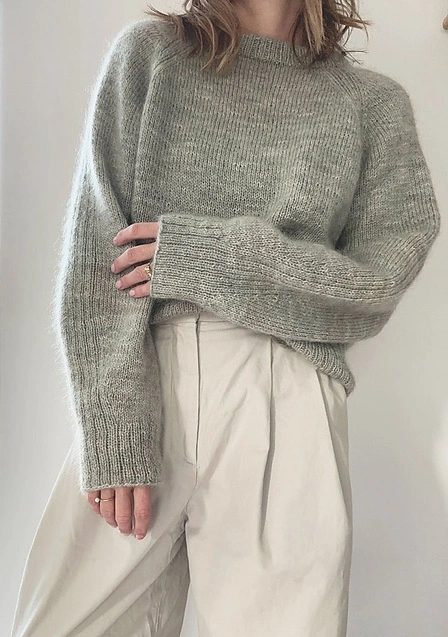 A classy sweater for normal people
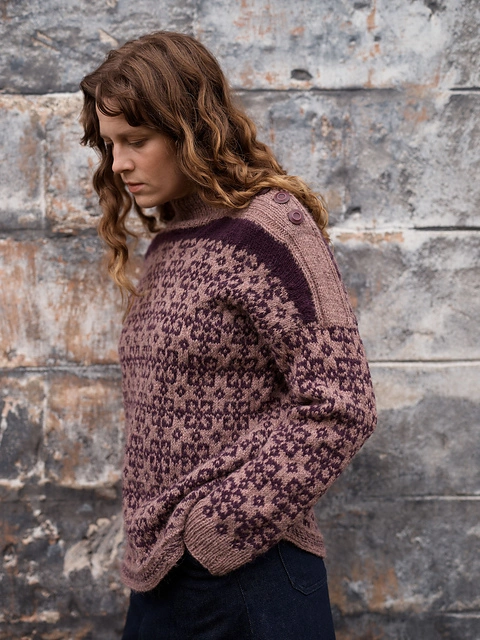 This peculiar thing I fully intend to make